
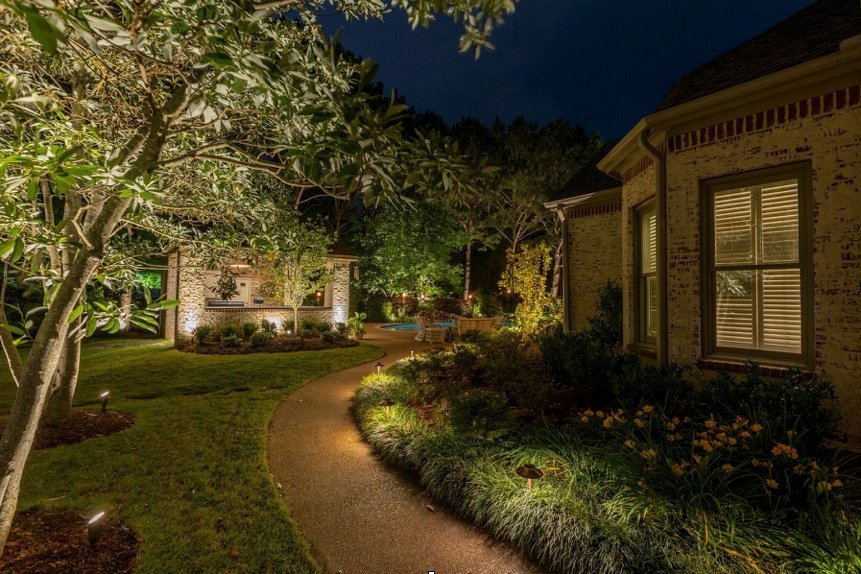
Landscape Lighting Design for Safety & Curb Appeal
Landscape Lighting: Design, Safety, and Year-Round Curb Appeal
Landscape lighting extends the usefulness of your outdoor spaces, improves safety after dark, and highlights the architectural and horticultural features that define your property. At Chris Johnson Landscapes, Chris personally develops the lighting design—selecting what to highlight, where to create contrast, and how the landscape should feel after dark—while execution and electrical oversight are handled by a retired electrical engineer to ensure the system is as technically sound as it is visually refined. Done well, landscape lighting is subtle, layered, and purposeful; never harsh or overdone.
Why Landscape Lighting Matters
Safety and Wayfinding
Low-glare path lights, step lights, and entry lighting reduce trips and falls while guiding guests naturally to doors and outdoor rooms. Proper beam control is critical—light should illuminate walking surfaces, not shine into eyes or neighboring properties.
Curb Appeal After Sunset
Most homes look their best at night when lighting is selective. Accents on specimen trees, textured walls, and focal plants add depth and contrast that daylight alone cannot provide.
Extended Use of Outdoor Spaces
Patios, porches, and gardens become usable well into the evening. Lighting effectively adds hours to your day without changing the footprint of your home.
Core Landscape Lighting Techniques
Uplighting
Placed at ground level and aimed upward to emphasize trees, columns, and architectural details. Best for specimens with strong structure or textured surfaces.
Path and Step Lighting
Low fixtures or integrated step lights that softly illuminate walking surfaces. Spacing and shielded optics matter more than brightness.
Wall Washing and Grazing
Even illumination across a surface (washing) or tight beams skimming texture (grazing). Excellent for stone, brick, and long foundation walls.
LED Lighting: The Residential Standard
Modern landscape lighting systems rely almost exclusively on LEDs for good reason:
– Very low energy use compared to halogen
– Long service life (often 25,000–50,000+ hours)
– Stable, predictable color temperatures
– Compatibility with timers, photocells, and smart controls
Modern LED landscape lighting is incredibly efficient. A typical 20‑fixture system using 3‑watt LEDs draws only 60 total watts—less than a single old‑fashioned incandescent light bulb. Running this system from dusk until dawn costs roughly $3.50 per month in electricity, based on average national residential rates.
For most residential landscapes, warm color temperatures in the 2700K–3000K range create the most natural and inviting appearance.
Avoiding Over-Lighting
– Layer light rather than flooding areas
– Conceal fixtures so the light effect, not the source, is visible
– Preserve darkness and shadow for contrast
– Balance the scene without rigid symmetry
In practice, fewer well‑placed fixtures almost always outperform brighter systems.
Engineering Oversight
All Chris Johnson Landscapes lighting system installations are overseen by Ken Hott, a retired electrical engineer who has been part of our business since its inception. His involvement ensures proper electrical loading, fixture layout, and long‑term system reliability, resulting in lighting that performs consistently, ages well, and avoids the common technical failures seen in poorly designed installations.
Why Winter Is a Smart Time to Install Lighting
– Darkness arrives earlier, revealing problem areas
– Dormant plants allow easier access and cleaner installation
– Immediate benefit during the darkest months
Lighting installed in winter delivers instant value and complements future landscape improvements.
Areas Typically Worth Lighting First
– Front entries and driveway transitions
– Primary walkways and steps
– Large trees near outdoor living spaces
– Feature walls and fireplaces
– Backyard zones used in the evening
Final Thoughts
Well‑designed landscape lighting improves safety, enhances curb appeal, and extends outdoor living—without drawing attention to itself. The most effective systems are quiet, intentional, and tailored to how the property is actually used.